

“Period poverty, simply put, is a lack of access to essential menstrual products and resources.”
Who is Yanique Branford, and what are you most passionate about?
I would describe myself as a creator, an entrepreneur and an advocate. I am a Black Female Biomedical Physicist, a milestone achievement as there are very few females in our field and even fewer BIPOC ones. To be honest, I wear many, many hats. My friends sometimes joke that I’m a jack of all trades but a master of none. Help a Girl Out officially started when I was 18 years old; everyone was confused about why I was so open and candid about something like menstruation. Most people, including most of my friends and family, were not very supportive initially. They were embarrassed for me because ‘period poverty’ wasn’t a socially recognized issue yet, and periods weren’t something people spoke up about. After being awarded Canada’s Hero Award, period poverty was acknowledged on the world stage. It became something that people started talking about, and other little organizations began popping up, and that’s when they were like, ‘Oh’.
What are you most passionate about?
I am most passionate about helping people, which comes in many forms. I’m a worship leader at my church, leading people in worship; that’s my absolute favorite thing, that’s my life dream, but other than when I am at church, most people don’t even know that I sing. When I started Help a Girl Out, it was another way for me to help people. I didn’t realize at the time that it would get this big — I’m grateful for all the lives we’ve impacted.
You mentioned that when you started Help a Girl Out, period poverty was not an issue that people spoke about. Can you explain what period poverty is?
Period poverty, simply put, is a lack of access to essential menstrual products and resources. In my opinion, the issue can be divided into situational and circumstantial variations of period poverty. Situational period poverty, the most common form, depends on your environment. For example, if you are in school when your period arrives unexpectedly and there are no products in your vicinity, you have to leave school — even if you have the means to afford menstrual products. In some lucky cases, you may strike up the confidence to ask a friend, but if they don’t have any products on hand, you are on your own. Girls fall behind, while boys don’t have this problem. It can be crippling for a child’s education — missing a class or assignment.
Circumstantial period poverty is different; it’s the worst case and the type I’m most experienced in. It is related to a lack of finances and low economic status, resulting in the inability to buy menstrual products regardless of where you are. In Jamaica, my mom would not let us stay home from school. You are from the Caribbean, so you will understand when I say that we grew up in the ghetto. So, because of this, she would say, ‘You need to go to school to make sure that we can get out of this place.’ So, my mum would make these giant uncomfortable contraptions for us to wear as pads. At the time, there were a lot of other girls who were experiencing the same thing. Some of them wouldn’t come to school and miss a whole week because, you know, the period is a week. When I immigrated to Canada, the same thing was happening here. This was disappointing because I figured that coming to a first-world country, I thought we made it out of poverty, but that was not the case.
When we arrived in Canada, getting a job as a new immigrant wasn’t easy, especially if your accent was strong or you didn’t have transferrable credentials. It was also tricky because our work experience was out-of-country and Canadian employers asked for up to 10 years of ‘Canadian’ experience.’ So, we were barely making ends meet and, of course, I was going to school without menstrual pads again — and I wasn’t the only one. Surprisingly, other students that were born here also weren’t able to afford menstrual products.
In some cases, they were from single-parent families with five sisters, so suddenly, $15 for a pack of pads was multiplied by five, and rent was already expensive. So, that’s an example of circumstantial poverty. There are probably many other examples like these.
Aside from your personal experiences was there a single thing that made you want to start Help a Girl Out, or was it the need to find solutions for yourself and your friends that propelled you to start Help a Girl Out?
Both. I got frustrated about the fact that I was seeing it in both countries. One day I was in the shower — on my period, and I realized that I was running out of pads again, and I just thought to myself, “why can’t someone just help a girl out?” Three years later, when faced with the question of what to call my organization, the phrase Help a Girl Out, was in the back of my head. When I got my first credit card, I was like 16 years old. I didn’t have a job, God knows why they gave me a credit card, right? I used it to buy pads for myself and my friends. Then everybody, even outside my friend group, started coming to me for help.
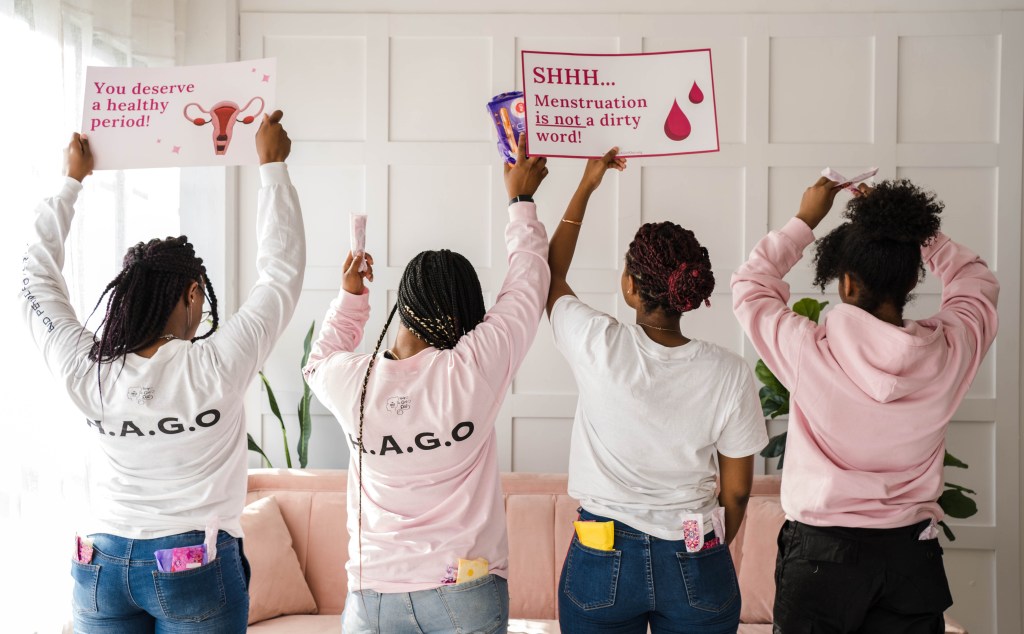
When I started my first year of university, I realized the demand for menstrual product support was too great; I couldn’t keep up. Someone who believed in what I was doing told me that if I created an organization, people would help by donating products, and I wouldn’t have to buy them, especially since I was also financially struggling. So, I decided, okay, what if I start something? I googled ‘how do you register a Not-for-Profit’ — It was a very straightforward application on the Corporations Canada website. So that’s when HAGO started, and it kept growing. I was lugging bags on Go trains and across various city transit systems daily — I still don’t drive. I gave out menstrual hygiene kits to individuals in schools, streets, shelters, etc. Some years after that, I met with Global Citizen, and they followed what I was doing in the community and nominated me & HAGO for the Canada’s Hero Award. We won — it was very unexpected. Still, it felt like a full-circle moment, a lifetime achievement, at 23 years old!
That’s Amazing, congratulations, on being Canada’s first-ever recipient of the Global Citizen Hero Award but also on having the courage to follow your dream and vision. You remained very focused, that’s fantastic!
I want to touch on some of the challenges you may have experienced. Did you have friends and family who would go out with you when you were making these donations or were you doing it alone?
Oh, no, no! My friends would not come near me with the long stick. When I started, it was just me, but I had a niece who, at the time, was five years younger than me. So, whenever I went out making donations on weekends or during the summer, I would take her along. On the day I registered for a charity bank account, I brought her with me so she could see — that it was possible to be young and make a difference. I had her, but she didn’t understand the vision. She was just trying to help her aunt. When we got a huge donation of hygiene products from Proctor and Gamble, that’s when my family was like… This is amazing! We’re with you now.
At the time, I lived in a one-room basement with my family, but Proctor and Gamble didn’t know that — they just used the address I gave them for the courier and shipped out skids from their warehouse. When the donations landed, they filled the driveway and some of the street in front of our significantly small dwelling. We were excited and panicked at the same time. We unpacked boxes for the whole day and the whole night. I think we finished unpacking boxes at 4:00 am. They filled our living room, the one bedroom, and the kitchen, and we slept on top of the shampoos and the soaps.
Now that I had the needed resources, nothing stopped me from doing outreach runs twice as often and supporting 10x as many people. As the donation piles got smaller and smaller, we were able to see our floors again. I had never been so happy to see them go — so we could sleep. But yeah, that’s when my family realized it was a real thing. It’s still embarrassing sharing my story, though, because nobody wants to hear that you were using cardboard, tissue, and all those things for pads. Meanwhile, girls in rural African villages used dung, dirt, or old clothes. In India, period poverty is rampant; people use whatever they can find.
After a while, a few more organizations started popping up, advocating for period poverty, but they would talk about it as if it was some farfetched issue, right? So, you had these organizations tossing two tampons here, two tampons there.
Aside from not initially having other people see and believe in your vision, were there any other challenges that you experienced?
Oh, yes. This whole organization is a challenge — because of the stigma around menstruation, we have to get creative. Every project or program we run has its obstacles and workarounds.
Stigma in what way? Speaking openly about menstruation; speaking openly about lack of access?
For example., you’d have to whisper what’s in the box if we were distributing the kits among some cultures, ethnicities or religious groups that are very against the idea of periods. If we label the kits with anything about periods or period poverty, even though they know they need it, some women, when they are with men from their family, would just walk past it, and you’d see them staring longingly at it as they walked past it. I mean even the people that need the help desperately. Sometimes they don’t want to accept help because they’re embarrassed.
It is easy to assume that we have gotten past that. I remember growing up when you bought sanitary pads, they were always put into brown paper bags.
Wrapped in one plastic bag and then another. (laughs)
What do you do when you see someone wanting the products and perhaps but not coming forward because of the stigma?
Well, we get creative. Oh, yeah. Sometimes I’d speak to the program coordinators face to face, and we’d make a distribution plan. For example, while distributing for the reusable project outside of Ontario, we had women (usually new immigrants and refugees) escorted to a room where they were momentarily separated from the rest of the family — and we said, “this room is just for the ladies.” When they went in and saw the reusable kits, they said, “oh my God, we had these in Afghanistan, but we had no idea where to find them in Canada. We are so happy for them.” They’d grab and stash them in their handbags or the bottom of the baby strollers so their husbands wouldn’t see them. That’s how we got most women to accept them. We also ship care packages throughout Ontario, and in those cases, they tell us specifically, “don’t put anything on the box that would identify what is in it.”
The most challenging part is reaching different religious groups. Getting some women of certain religions to speak about their periods is like pulling teeth, but we have found ways to address that. For example, I have progressive friends from diverse backgrounds, and we know that representation matters in our campaigns, photos, and little movies. At our packing parties, we always have a range of volunteers from different religious and ethnic groups so that when people are looking for help, they see other people who look like them.
Do you have a large team working with you now?
It grows and shrinks as people come and move on. It’s a large team, with different people always pitching in. Regarding volunteer sewers, we have about 120 persons across the country creating reusable pads for us. We also have about 20 volunteers who drop off kits or pack kits or run the social media. So yeah, depending on our projects or the time of year, our team grows and shrinks.
Are all of your volunteers Female?
No, we have guys who usually opt to drive or come to our packing parties to help out. We also have a lot of husbands, you know, they’d come along as ‘manpower,’ lifting and moving things for us. We also try to include them in our educational workshops, but it’s a hit or miss — you just have to know how to deliver the message, so they’ll feel comfortable.
What are some of the successes that you’ve been most proud of since starting Help a Girl Out?
Honestly, I’m proud of everything because sometimes things turn around at the last minute by the grace of God, and I’m over the moon. Recently, we collaborated with Food for the Poor in Jamaica, and I don’t know if you know anything about customs in Caribbean countries (laughs) — it’s a challenge.
With Food for the Poor, we were able to support ten different orphanages. We sent 300 kits with everything, from full-size shampoos, deodorants, and menstrual products to educational materials. Each kit weighed like 6 pounds! When I started HAGO, one of my pursuits was to help people back home where I experienced period poverty first. The goal was not just to help them with products but to help them reduce the stigma because when you bring down the stigma, that is more of an impact than merely giving somebody a pack of pads. So that was very important to me. Food for the Poor also provided an impact report with all these photos and quotes about how much the recipients appreciated it. In the orphanages, the girls would have to sign out whatever product they would use. So, they would have to sign up for the soap bar and then sign it back in. Now they have their own, so they’re like, “we don’t have to sign anything out. We have our own.”
That’s great work. Do you always distribute personal hygiene products along with menstrual products?
Yes, that’s very important to me. Our kits also have hygiene products in them because if they can’t afford pads, they probably can’t afford something like soap or shampoo either. We try our best to stretch our support as far as we can.
I know you touched on some of them before, but what are the main misconceptions about period poverty?
A big one is that only homeless people experience period poverty. I keep explaining to people that period poverty is not written on someone’s face. For example, in some countries, you have girls who would trade sex for pads. After securing payment from these men, these girls would end up having nice jewelry and clothes — obscuring the signs of poverty and the underlying situation.
Another misconception about menstruation is that it’s dirty and comes from a lack of education. Sometimes when I speak with very bright and intelligent folks, they have this utterly ridiculous belief that period blood is dirty because it is waste from different organs in the body. Pulling down these myths — especially when people are strong in their opinions- is challenging and sometimes exhausting. The problem is, if left unchecked, these misconceptions are passed onto kids. So, parents or teachers must take the time to learn the truth and explain it adequately.
That takes me to my next question how do we begin to have these meaningful conversations about menstruation, and what actions can we take to remove some of those stigmas?
Education. For example, many moms, when they come to drop off their daughters or sons, ask us for ideas on how to talk about this topic in their household. I tell them, YouTube is an excellent resource for information, and so is Google. You can find out exactly what a period is — either read it up on Google or just YouTube it. They even have animations for kids. If you don’t want to do the research, you can join one of HAGO’s educational workshops. We’ll teach you.
When I started Help a Girl Out, I did it to fix the problem of lack of access to menstrual products, but I was still stuck in the stigma. I realized that I couldn’t continue doing Help a Girl Out if I didn’t get rid of the stigma and remove it from my household. So, I started talking about it with my family and friends. I would start a conversation whenever they came to get a pad and because of those conversations, some of my friends realized they had certain medical conditions. One of my friends, who is Muslim, did not know that you were supposed to have a menstrual period every month. Another one, because of our conversations decided to see a doctor for some of the symptoms she was experiencing every month and she was diagnosed with fibroids. Uterine illnesses are rampant and undiagnosed, especially in the black community. People think, “my period is just gross and painful, but that’s just the way it is”. Painful periods are a sign of something underlying. Speak to your doctor. The problem is that nobody is talking to them about this, so they leave it, and it leads to all sorts of issues later on.
I am sure you’ve read that Scotland recently became the first country to make menstrual products free. Do you think a similar approach would be helpful in Canada and in other countries?
Oh, absolutely. Canada could have been the first. A global organization gave this girl working on period poverty out of her basement ‘Canada’s Hero Award’ — this should have nudged Canada forward. Still, I think it is easy to talk about period poverty if it is in a far-away place like Africa or the Caribbean, but people are shocked and hate to hear that it is happening here in Canada too. When I won my award, Canada was highlighted as a country that had someone doing work on this issue. Global Citizen only named six countries — The other countries were focused on issues like water security, and other things, but period poverty was highlighted on the world stage as a Canadian issue. Canada could have been the first country to make menstrual products more accessible — they chose not to.
Recently the government budgeted 25 million for a pilot project for menstrual equity. I am not into politics, but I’m confident that we don’t need another pilot project. With $25 million, I can end period poverty in Canada — I don’t even need that much.
From your work, do you think that perhaps at the time there was a perception that the problem was not widespread in Canada?
Yes, I don’t think many people believe that period poverty in Canada is a big enough issue to warrant its platform. Now with Scotland leading the world showing that it can be an issue in developed countries, I think people are starting to pay attention. I believe that now that Scotland has moved to free menstrual products, Canada will follow — eventually.
Are there many organizations/groups across Canada working on period poverty?
Oh, yeah. In the spring of 2020, something happened. I am not sure what, but people caught on, and these organizations started popping up. Some of them had chapters at colleges. Some were young kids who had just started menstruating in their community and were just giving donations to homeless shelters. Some of the groups grew to be more influential organizations. There’s one chapter called Bleed the North. They don’t do much of the providing access part, but they have been doing work to raise awareness. They toured different schools in the GTA and brought the issue to the attention of high school students. So, yeah, there’s a whole movement going on now. After launching Help a Girl Out in 2018, I found out that there was an organization in Toronto called the Period Purse. They were around before we were. I always joke and tell my friends that if I knew they existed, I probably would have been a volunteer instead of starting my own organization. I could have gotten donations from them to give to my community — But I didn’t know.
What do your outreach initiatives look like, and how can people become involved?
We have a variety of programs. During the pandemic, we started two huge projects, and they’re continuing because they support so many people. For our period product support program (PPSP), we pack one, two or three-month supply kits and ship them out or send them out to volunteer drivers to deliver to individual homes or community and youth centers.
The other project we started during the pandemic was our reusable program. We have sewers all across Canada sewing reusable cloth menstrual pads. They sew them and send them back to us to pack — we fill the kits with other sustainable hygiene products and send them out to high- risk individuals or refugee centers because they know how to use and appreciate the reusable pads. We’ve introduced sewing classes as well to teach individuals how to sew so that they can make their own pads, they can sell for us, or just learn the skill. Yeah, you asked before what I was most proud of, I am so proud of that project because it was a beast to get off the ground. The impact that it has had so far has stemmed across so many different areas. Eventually, I could break it off from Help a Girl Out and create a separate entity. We’ve also taught folks in Italy, Mexico, Uganda, etc. how to start a project like it in their own country and they’re making an impact — it’s definitely more significant than I thought it was going to be.
We should have also said that you are a visionary. If I’m a young lady who is experiencing period poverty, how do I access the products that are available through Help a Girl Out?
There’s an application form on our website. You can also reach out to us by email. The email address is also on our website. We also receive messages through Instagram, but I prefer they use the application form because we ask specific questions that allow us to understand your situation and menstrual flow. We can then tailor the kits to specific needs. We ask questions like “do you prefer light, medium or overnight pads?” — because those are important questions. For example, if you send somebody very thin pads and they have a heavy flow, you may as well have sent toilet paper.
Can individuals who are interested in volunteering also reach out through the website?
Yes.
Do you have a favorite quote or affirmation quote?
Um, it’s a bit unconventional. It’s not a quote, but I’m a worshiper. It keeps me grounded and sane and renews my strength daily.
What’s next for Yanique Brandford?
What’s next for me as an individual or Help a Girl Out?
Both. Where would you like to see Help a Girl Out go as an organization, and do you have any personal goals that you would like to see come to fruition?
I am looking forward to graduating as a full-fledged scientist. I don’t know what employment I’m going to move into because there are so many different areas where one could specialize. I don’t even want to open that can of worms. I just want to walk across the stage and say thank God, I made it. I also want to get a good job because even though Help a Girl Out is a very successful organization, I’m still low-income, and I can barely afford life myself sometimes. When I read these application forms requesting help, I’m not reading from a pedestal; I’m reading from, “I see your problem, girl. I know, I feel it too”.
For Help a Girl Out, we have two other outreaches this year where we’re going to help this grassroots activist in Jamaica and another collaboration with Food for the Poor in Honduras.
Thank you for taking the time to speak with me today. It has been uplifting and inspiring listening to you. You have big dreams and a passion for what you’re doing, and I have no doubt that you’re going to be very successful, whether it be in the science field or in growing Help a Girl Out. If there’s anything I can do to help bring more attention to this important work, please let me know, I’m more than willing to help.
Instagram: @helpagirloutcharity
One response to “A Q&A Conversation with Yanique Brandford Founder and Executive Director – Help A Girl Out (HAGO) & Canada’s First Recipient of the Global Citizen Hero Award”
Reading through this interview gave me goosebumps the entire time not only because Yanique’s journey is extremely remarkable and inspiring but also the way this conversation has been carried out and the interview was put together. Yanique, you really are a shining light, a Hero and a change maker. The world needs more and more people like you!