
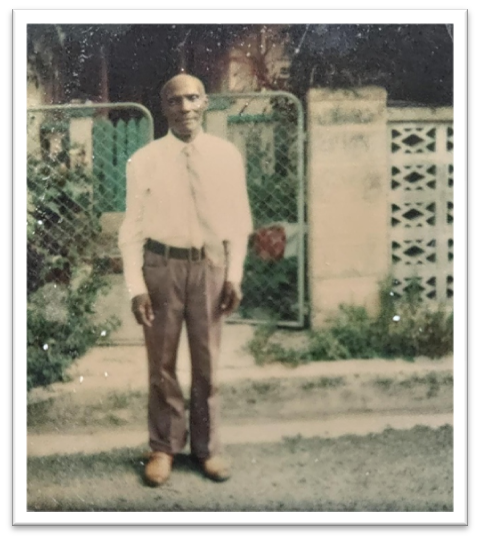
My grandfather Joseph was born in 1902. His stature was eclipsed by his personality. He left school at the age of fourteen to become a mason and traveled across the Caribbean, Latin America and the United Kingdom in search of work.
For a few years, my sister and I called him Daddy Layne. That moniker lacked childlike creativity, so it had to have been suggested by an adult. When he came to live with us in 1979 after the death of my grandmother, my sister and I decided that a name change was in order. He couldn’t be granddad because that was what we called my maternal grandfather, Grandpa sounded too old and formal and just did not suit him. We decided on Gramps because he was a little bit grumpy and just seemed like a Gramps to us.
Gramps died in 1984 when I was thirteen years old. Its hard to believe that he only lived with us for five years because the time seemed so much longer and those were the most consequential years of my life. He called me Marie (Ma-Rie) and we were kindred spirits, fascinated with people and the world around us. Like him, I am apt to hold a grudge, loyal to a fault and impatient with silliness, yet he would often remind me that, “A little nonsense now and then is relished by the wisest men.” I know without a doubt that he loved me. He was my anchor. Whenever I had a disagreement with my parents, he would console me and explain why they were right. He would also stand up for me when he thought that they were being unreasonable.
More than three decades have passed since his death, but he is rarely out of my thoughts. Seeing a photo of him still brings a smile to my face and tears to my eyes.
I remember becoming emotional when I visited the Panama Canal and watched in awe as the Canal locks opened and closed. Although I don’t know the specific work he did when the Canal was being constructed, just knowing that he had contributed in some way to this engineering masterpiece, was deeply moving. I remember thinking that I was truly walking in his footsteps.
As I reflect on the time that I spent with Gramps, I realise that he never spoke to me in a childlike manner. He always acknowledged my intelligence and when I asked questions, he answered them directly. When he told me stories, he never tried to shield me from the realities of the world. He could be harsh in his comments and falling outs were a regular thing with us, but my family knew that we were two peas in a pod, and it was only a matter of time before we would get over our anger and back to being buddies.
The value of Hard Work
Gramps, like many of his generation did not like to be idle. Even though he was well into his seventies, he was in good health and had no appetite for rest and leisure, “the devil finds work for idle hands to do,” was his constant refrain. In 1980, we moved into the house that is now our family home. It was a new development so there was a lot of landscaping that needed to be done. Gramps wanted to plant a vegetable garden; my dad wanted a lawn. Gramps was adamant that it was “better to plant food than grass.” That was Gramps – always focused on the practicability of thing and not the aesthetics. Thankfully, the standoff ended with a compromise, we got a lawn and a vegetable garden.
Gramps also decided that he wanted to build the wall that would surround the front of the house. My dad thought it was too much for a man in his 70s to do even with help, but Gramps was adamant that it was a waste of money to have a construction company erect the wall when we had in house know-how at our disposal. Even though I knew my grandfather was a mason, I never had the opportunity to see him at work. I learnt later that he had also built the home that my father grew up in. I remember watching my father, grandfather and a few friends working together every weekend digging the foundation for the wall, and my grandfather acting as foreman correcting any missteps that were made. Though neither of them ever said so, I believe it strengthened their relationship and their respect for each other. Gramps would also build the form that would be used to create the shape of blocks that he would later use to make the two main columns for the wall. When a truck backed into the wall and damaged part of it a few months later, Gramps tirelessly worked to rebuild it. More than 30 years later that wall is still standing – an enduring gift to our family and a symbol of his hard work.
Old Habits Die Hard
For all his good traits, my grandfather’s biggest vice was his smoking. He was a heavy smoker. So committed was he to this foible, I am told that while working in the United Kingdom, he learnt to make his own cigarettes, using cigarette paper and tobacco.
He told me that he started smoking when he was working on the tobacco plantations in Cuba. At that time, dengue fever was prevalent, and he took up smoking to keep the mosquitoes away. Gramps always had a pack of his favorite 555 cigarettes in his shirt pocket. In his younger days it was Lucky Strike and Raleigh. His mood would be much less amicable when he ran out of cigarettes. Despite our best efforts, he never really tried to kick the habit.
I recall vividly, that every few days he would go for a walk and would come back with a fresh supply of cigarettes. One day he left on one such walk and did not return. We were terrified that something had happened to him. I stood for hours by the window at the front of the house waiting for him. My dad drove the route that he normally walked frantically looking for him worried that he may have been injured or that some harm may have come to him. My dad returned much later, having done an exhaustive search, without my grandfather. It was dark by then and I can still remember the gut-wrenching fear that I felt. Gramps would come home a short time later in a fit of anger. He had spent the day at the shop waiting for a young man to return with a box of cigarettes that he had promised to go purchase for my grandfather from another nearby shop. My grandfather refused to believe that the young man would steal money from him, a senior citizen, but he had. Gramps fumed for several days after the incident, he was filled with righteous indignation at what this incident represented to him – a decline in the fabric of society and perhaps in families. To him, stealing from a senior citizen was the ultimate mark of disrespect. He was even more annoyed because his walks to the shop had been brought to an unceremonious end since my father decided to start purchasing his cigarettes by the carton.
His Legacy
Several months before gramps died that he told me that he was tired, and he was ready to go home ‘but you are home,’ I remember telling him not quite understanding what he was saying. ‘No Marie, I am ready to go meet my maker’ he said. I remember running to my mother in tears and she tried to console me. She assured me that he was in good health and was probably just tired or having a bad day. I am always overcome with emotion whenever I recall this conversation because I now believe he was trying to prepare me for what he knew was to come. Some time after that conversation, his health gradually began to decline and by August of the following year my beloved Gramps was gone.
Even though he is long gone, Gramps left me with a treasure trove of stories which delight me to this day and have been the source of many conversations between me and my dad. His lessons about life are as valuable as ever – family is everything, work hard for what you want, your word is your bond, be curious. Gramps was without pretension, he was authentically himself, and he taught me not to let the vicissitudes of life change who I am. Although he never shared details about the injustices or prejudices he experienced while he worked abroad, it was clear from the little that he did say that he had been deeply affected but not broken by what he had experienced. He never lost his jest for life or adventure, he left room for disappointment and delighted in the unexpected.